Tell us about the job
Takes about a minute. No obligation.
A furnace repair in Arapahoe County starts with the burner assembly and ignition system, because those are the parts that absorb every heating cycle the equipment runs. Homes in Arapahoe County, CO run heat about eight months a year, from October through May. Each startup and shutdown works the igniter, the flame sensor, and the heat exchanger incrementally, and a season this long does not leave much idle time for wear to hide. A contractor diagnosing a fault here checks those components first, because that is where accumulated stress shows up as a cracked exchanger, a failing igniter, or a sensor coated enough to misread the flame.
Once a furnace is open, what decides the repair is whether the cracked heat exchanger, worn inducer, or failed limit switch takes a part that is still being made. In stock this old, that question comes up more than it does in newer housing, because the gap between what the furnace was built to be and what replacement catalogs now carry has had time to widen. Half the homes in Arapahoe County, Colorado were built in 1986 or earlier (2020-2024 ACS 5-year). A contractor working through a repair here checks parts availability before quoting labor, because a job priced against a part that turns out to be discontinued becomes a different conversation entirely.
The Parts of a Furnace a Contractor Checks First
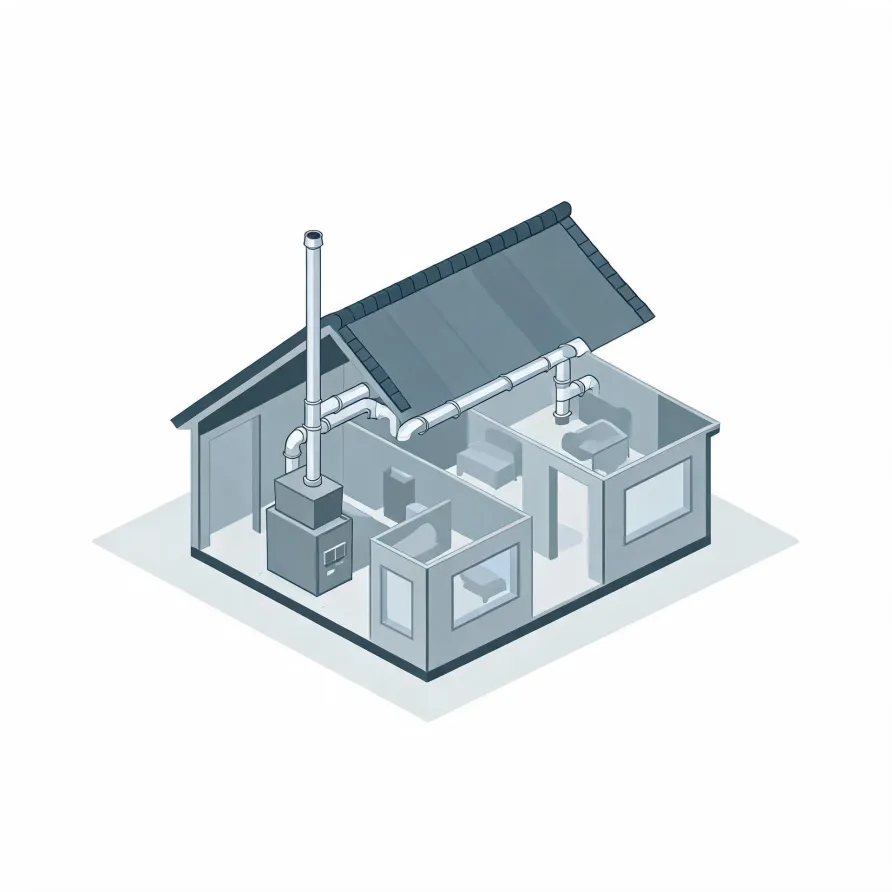
The heat exchanger sits at the core of the furnace cabinet and is where combustion gases do their work. Cracks or stress in that metal are a common reason a furnace stops heating safely. The burner assembly, just below it, is the first thing a contractor looks at when the unit runs but produces little or no heat.
The inducer motor pulls combustion gases out through the flue and is an early suspect when a furnace short-cycles or refuses to start. The blower motor sits at the base of the cabinet and pushes conditioned air into the supply side. The control board ties both of them together, and a fault there can mimic almost any other failure.
The drawing shows the general layout of a furnace system, and a licensed contractor determines which components apply to your specific equipment and installation.
Get matched in Arapahoe CountyArapahoe County, by the numbers
360 severe weather events were recorded in Arapahoe County, Colorado between 2015 and 2024.
NOAA National Centers for Environmental Information, Storm Events Database, bulk CSV export, events 2015-01-01 through 2024-12-31.Half the homes in Arapahoe County, Colorado were built in 1986 or earlier (2020-2024 ACS 5-year).
U.S. Census Bureau, 2020-2024 American Community Survey 5-Year EstimatesArapahoe County, Colorado holds 269,345 housing units (2020-2024 ACS 5-year).
U.S. Census Bureau, 2020-2024 American Community Survey 5-Year EstimatesOwners occupy 64.7% of the occupied homes in Arapahoe County, Colorado (2020-2024 ACS 5-year).
U.S. Census Bureau, 2020-2024 American Community Survey 5-Year EstimatesCodes & Standards Governing Furnace Repair in Arapahoe County, Colorado4 sourced rules and standards
What the repair visit looks like
Non-weatherized gas furnaces manufactured on or after November 19, 2015 must reach 80.0 percent AFUE.
Non-weatherized oil-fired furnaces manufactured on or after November 19, 2015 must reach 83.0 percent AFUE.
Mobile home gas furnaces manufactured on or after November 19, 2015 must reach 80.0 percent AFUE.
Non-weatherized gas furnaces manufactured on or after December 18, 2028 must reach 95.0 percent AFUE, up from the 80.0 percent minimum that applies to units manufactured before that date.
Severe Weather Events in Arapahoe County
Extreme weather puts real stress on furnace systems, cycling them hard and pushing components toward failure. How much of that pressure your equipment faces is a local question, and the answer shifts by county.
360 severe weather events, 2015–2024. Source: NOAA National Centers for Environmental Information, Storm Events Database.