Tell us about the job
Takes about a minute. No obligation.
A furnace repair in Delta County starts with the parts that do the most work: the burner, the heat exchanger, and the ignition system. Homes in Delta County, CO run heat about nine months a year, from September through May. Each cycle through that season stresses the igniter and the heat exchanger in ways that add up over years. A contractor pricing a repair here checks those components first, because that is where wear concentrates on a system that fires and shuts down repeatedly across a long heating season. A cracked heat exchanger found during a repair call is rarely a surprise.
Ductwork in a house this old was fitted for systems that no longer exist, and the furnace sitting in that ductwork has likely been swapped at least once since the house was framed. Half the homes in Delta County, Colorado were built in 1979 or earlier (2020-2024 ACS 5-year). When a contractor opens a furnace in stock like this, the question is whether the failed component still has a supply chain. Heat exchangers, draft inducers, and control boards from older equipment run into discontinued part numbers, and a repair that looks straightforward from the outside can stall on sourcing before a quote is final.
The Parts of a Furnace a Contractor Checks First
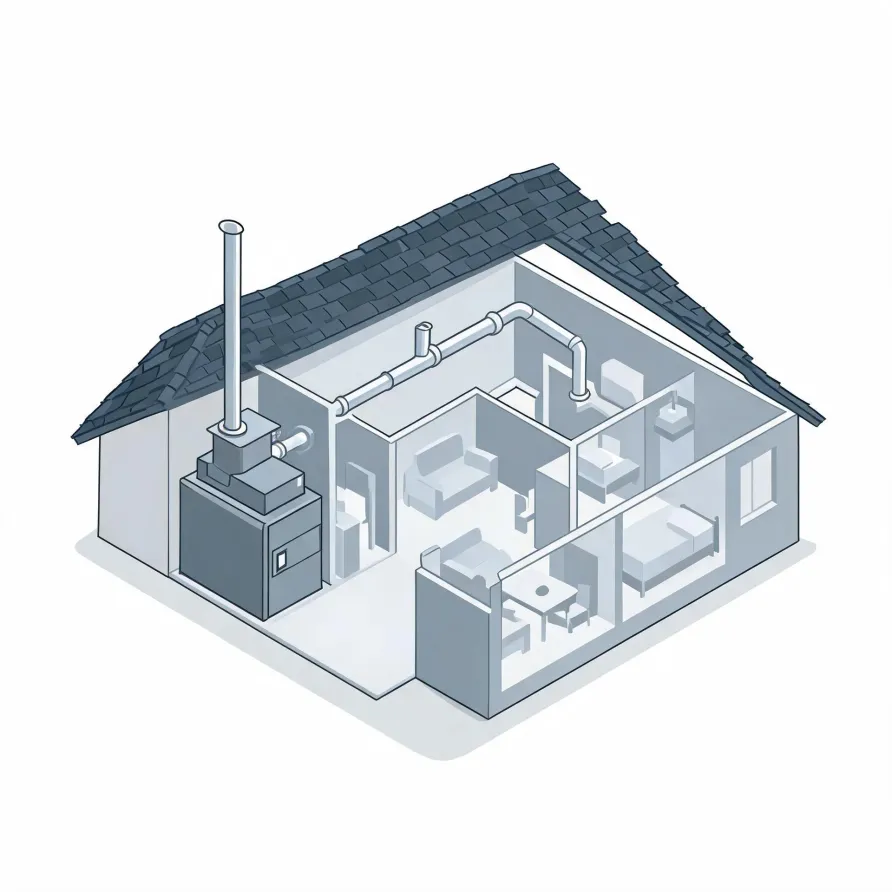
The furnace itself sits in a utility space, basement, or closet and is the piece a contractor goes to first. Inside it, the heat exchanger and burner assembly are the usual suspects when heat stops coming or comes unevenly. A cracked heat exchanger, a failed ignitor, or a burner that won't light accounts for a large share of no-heat calls.
The blower motor pushes conditioned air out through the supply side and draws return air back in. The flue pipe runs from the furnace to an outside vent and removes combustion gases. The thermostat, mounted on a wall inside the living space, is where a contractor often starts before touching anything mechanical, since a wiring or calibration fault there can mimic a furnace failure.
The drawing shows a representative layout, and a licensed contractor determines which components apply and need attention in your specific home.
Get matched in Delta CountyDelta County, by the numbers
234 severe weather events were recorded in Delta County, Colorado between 2015 and 2024.
NOAA National Centers for Environmental Information, Storm Events Database, bulk CSV export, events 2015-01-01 through 2024-12-31.Half the homes in Delta County, Colorado were built in 1979 or earlier (2020-2024 ACS 5-year).
U.S. Census Bureau, 2020-2024 American Community Survey 5-Year EstimatesDelta County, Colorado holds 15,025 housing units (2020-2024 ACS 5-year).
U.S. Census Bureau, 2020-2024 American Community Survey 5-Year EstimatesOwners occupy 77.9% of the occupied homes in Delta County, Colorado (2020-2024 ACS 5-year).
U.S. Census Bureau, 2020-2024 American Community Survey 5-Year EstimatesCodes & Standards Governing Furnace Repair in Delta County, Colorado4 sourced rules and standards
What HVAC Repair Looks Like in Delta County
Non-weatherized gas furnaces manufactured on or after November 19, 2015 must reach 80.0 percent AFUE.
Non-weatherized oil-fired furnaces manufactured on or after November 19, 2015 must reach 83.0 percent AFUE.
Mobile home gas furnaces manufactured on or after November 19, 2015 must reach 80.0 percent AFUE.
Non-weatherized gas furnaces manufactured on or after December 18, 2028 must reach 95.0 percent AFUE, up from the 80.0 percent minimum that applies to units manufactured before that date.
Severe Weather Events in Delta County
Furnaces in Delta County work against whatever the climate puts on them, and the strain of hard weather shortens parts, stresses heat exchangers, and pushes systems toward failure. That pattern is local, which is why repair needs here are best handled by contractors who know this area.
234 severe weather events, 2015–2024. Source: NOAA National Centers for Environmental Information, Storm Events Database.