Tell us about the job
Takes about a minute. No obligation.
Homes in Cheyenne County, CO run heat about eight months a year, from October through May. A furnace running that long puts its hours into three places: the burner, the heat exchanger, and the ignition system. Every firing cycle stresses the exchanger's metal, and a contractor called out for a repair checks that surface carefully before quoting anything else. Cracks there are not cosmetic. They let combustion gases into the living space, and a contractor who skips that inspection leaves the homeowner with an unfinished diagnosis.
Older ductwork and sealed compartments hold their history. Half the homes in Cheyenne County, Colorado were built in 1968 or earlier (2020-2024 ACS 5-year). A furnace that has run in a house of that vintage has often been retrofitted at least once, and the components a contractor pulls out when the unit is open may not match anything on a current parts list. That gap, between what the failed component is and what a distributor can ship, is where furnace repair in this county gets decided.
The Parts of a Furnace a Contractor Checks First
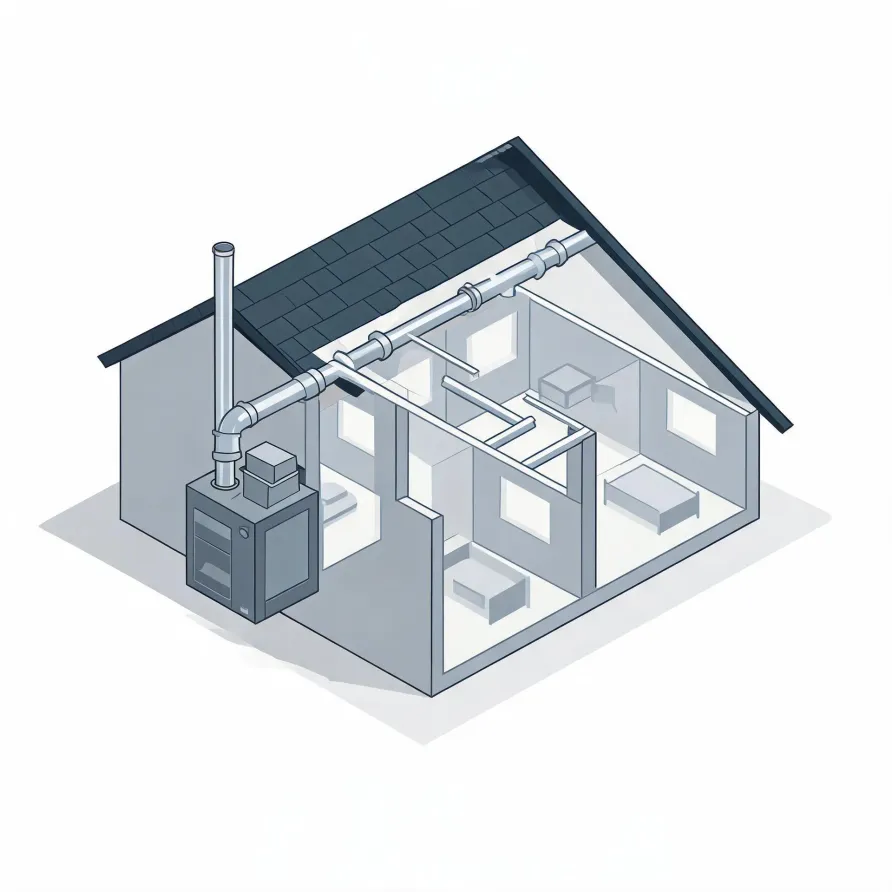
The heat exchanger sits at the core of the furnace cabinet in the basement or utility room and is the piece that actually warms the air moving through your home. Cracks or failures here are serious. The burner assembly feeds into it, and when ignition problems arise, that assembly is where a contractor looks first.
The blower motor and its fan sit just below or beside the heat exchanger and push conditioned air into the duct system. The flue pipe runs from the top of the cabinet up and out of the house, carrying combustion gases away. Problems with airflow or venting often trace back to one of these two components.
The drawing shows a typical furnace layout, and a licensed contractor determines which parts apply to the specific equipment and installation in your home.
Get matched in Cheyenne CountyCheyenne County, by the numbers
288 severe weather events were recorded in Cheyenne County, Colorado between 2015 and 2024.
NOAA National Centers for Environmental Information, Storm Events Database, bulk CSV export, events 2015-01-01 through 2024-12-31.Half the homes in Cheyenne County, Colorado were built in 1968 or earlier (2020-2024 ACS 5-year).
U.S. Census Bureau, 2020-2024 American Community Survey 5-Year EstimatesCheyenne County, Colorado holds 986 housing units (2020-2024 ACS 5-year).
U.S. Census Bureau, 2020-2024 American Community Survey 5-Year EstimatesOwners occupy 72.6% of the occupied homes in Cheyenne County, Colorado (2020-2024 ACS 5-year).
U.S. Census Bureau, 2020-2024 American Community Survey 5-Year EstimatesFurnace Repair Rules & Codes for Cheyenne County, Colorado4 sourced standards and regulations
What the repair visit looks like
Non-weatherized gas furnaces manufactured on or after November 19, 2015 must reach 80.0 percent AFUE.
Non-weatherized oil-fired furnaces manufactured on or after November 19, 2015 must reach 83.0 percent AFUE.
Mobile home gas furnaces manufactured on or after November 19, 2015 must reach 80.0 percent AFUE.
Non-weatherized gas furnaces manufactured on or after December 18, 2028 must reach 95.0 percent AFUE, up from the 80.0 percent minimum that applies to units manufactured before that date.
Weather Stress on HVAC Equipment in Cheyenne County
Heating equipment in Cheyenne County works against whatever the climate puts on it, and that workload shows up as wear, breakdowns, and shortened service life. How hard a furnace runs over years is a local question, and the pattern of severe weather here is part of that answer.
288 severe weather events, 2015–2024. Source: NOAA National Centers for Environmental Information, Storm Events Database.