Tell us about the job
Takes about a minute. No obligation.
A furnace repair in Bent County starts with the parts that actually cycle. Homes in Bent County, CO run heat about seven months a year, from October through April. The burner, the igniter, and the heat exchanger are doing that work season after season, and a contractor opening a unit here will check those components before anything else. Cracks in a heat exchanger or a degraded igniter are not surprises in this area; they are the predictable output of that much accumulated runtime. Secondary controls and electrical components can wait until the primary wear points are ruled out.
Furnace systems installed in houses built for earlier equipment run on parts that are harder to find than a catalog search suggests. Half the homes in Bent County, Colorado were built in 1959 or earlier (2020-2024 ACS 5-year). A contractor opening a furnace in stock that old finds components whose replacement parts may exist in a regional warehouse, or may require fabrication, or may simply not exist in that form anymore. That gap between what the system takes and what distributors currently stock is what decides whether a repair closes in a day or stretches into a longer conversation about what comes next.
The Parts of a Furnace a Contractor Checks First
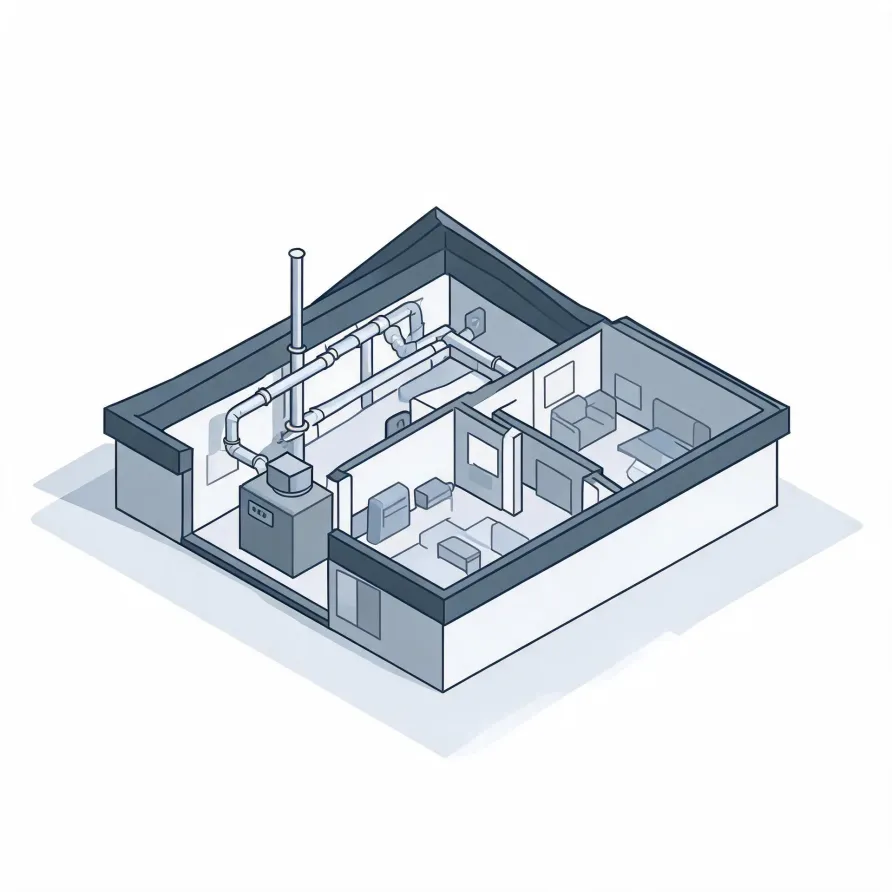
The furnace itself sits in the basement, utility room, or closet and is where combustion happens and air gets heated. Inside it, the heat exchanger is the first place a contractor looks when something is wrong. A cracked exchanger, a failed ignitor, or a faulty burner assembly are the parts most often behind a furnace that won't start, won't stay lit, or blows cold air.
The blower motor pushes heated air out through the supply side of the house and sits inside the furnace cabinet. The flue pipe runs from the unit to an exterior wall or roofline and carries combustion gases out. The condensate drain and pressure switches on high-efficiency units get checked too, because a blocked drain or a failed switch will shut the whole system down.
The drawing shows a typical furnace layout, and a licensed contractor determines which components apply and what condition they are in for your specific system.
Get matched in Bent CountyBent County by the numbers
86 severe weather events were recorded in Bent County, Colorado between 2015 and 2024.
NOAA National Centers for Environmental Information, Storm Events Database, bulk CSV export, events 2015-01-01 through 2024-12-31.Half the homes in Bent County, Colorado were built in 1959 or earlier (2020-2024 ACS 5-year).
U.S. Census Bureau, 2020-2024 American Community Survey 5-Year EstimatesBent County, Colorado holds 2,174 housing units (2020-2024 ACS 5-year).
U.S. Census Bureau, 2020-2024 American Community Survey 5-Year EstimatesOwners occupy 65.2% of the occupied homes in Bent County, Colorado (2020-2024 ACS 5-year).
U.S. Census Bureau, 2020-2024 American Community Survey 5-Year EstimatesCodes & Standards Covering Furnace Repair in Bent County, Colorado4 sourced rules & standards
What HVAC Repair Looks Like in Bent County
Non-weatherized gas furnaces manufactured on or after November 19, 2015 must reach 80.0 percent AFUE.
Non-weatherized oil-fired furnaces manufactured on or after November 19, 2015 must reach 83.0 percent AFUE.
Mobile home gas furnaces manufactured on or after November 19, 2015 must reach 80.0 percent AFUE.
Non-weatherized gas furnaces manufactured on or after December 18, 2028 must reach 95.0 percent AFUE, up from the 80.0 percent minimum that applies to units manufactured before that date.
Weather Pressure on HVAC Equipment in Bent County
Furnaces in Bent County work against the local climate, not some average one. Stress from severe weather shortens equipment life and drives up repair frequency, which is why the conditions here matter when you are deciding whether to repair, service, or replace.
86 severe weather events, 2015–2024. Source: NOAA National Centers for Environmental Information, Storm Events Database.